OUR MISSION STATEMENT
Mission & Mandate
The Fahmy Foundation works to defend press freedom, advance human rights, and prevent radicalization through informed public education and rights-based, community-led approaches. Its mission centers on protecting journalists at risk, countering extremist ideologies, strengthening democratic values, and promoting accountability through evidence-based advocacy and prevention initiatives.
Established in 2015 by Egyptian-Canadian journalist and human rights defender Mohamed Fahmy following a successful global campaign for his release from unjust detention in Egypt, the Foundation draws on lived experience, legal advocacy, and frontline research to drive impactful, principled action.
Mission & Mandate
The Fahmy Foundation is dedicated to protecting press freedom, advancing human rights, and preventing radicalization through informed public education and rights-based, community-led initiatives.
The foundation leverages lived experience, legal advocacy, and frontline research to drive principled and impactful action worldwide.
It was established in 2015 by Egyptian-Canadian journalist and human rights defender Mohamed Fahmy and his legal team following a global campaign to secure his release after 438 days of unjust detention in Egypt’s maximum-security prisons.
What We Do
Its mission focuses on advancing intiatives led by the Foundation’s team of veteran advocates, practitioners, and human rights professionals through the following programs:
- Protection Charter – Protecting Canadians detained abroad and strengthening government accountability
- Defending Journalists – Defending press freedom through targeted advocacy and protection
- Canada Act Now – Confronting extremist ideologies, strengthening democratic values, and advancing evidence-based prevention and counter-radicalization
- Journalists in Distress Fund – Providing financial and non-financial support to journalists facing legal persecution and arbitrary detention
The Fahmy Foundation is built on three core pillars—Advocacy, Assistance, and Awareness—advancing justice, freedom, and human dignity.
ADVOCACY
ASSISTANCE
AWARENESS
These pillars are deeply informed by Mohamed Fahmy’s multi-decade frontline reporting in the Middle East and his humanitarian work with the International Committee of the Red Cross (ICRC), where he served on protection teams operating inside Lebanon’s prison system and conflict-affected communities.
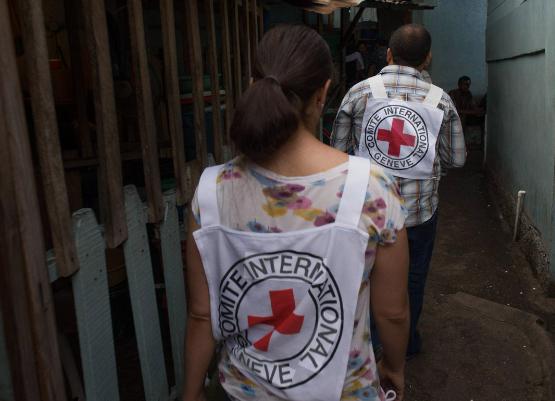
Personnel from the International Committee of the Red Cross (ICRC) during a humanitarian mission
While working with the ICRC, Fahmy conducted confidential, unescorted human rights interviews with hundreds of detainees inside Lebanese prisons. These included senior political detainees, Islamists affiliated with the Muslim Brotherhood, and members of jihadist groups—most notably militants affiliated with Fatah al-Islam, a Sunni extremist organization whose remnants later merged into al-Qaeda–aligned networks operating in Lebanon and Syria. This work, carried out without the presence of government officials, provided rare and direct insight into extremist recruitment pathways, ideological narratives, detention-based radicalization, and the complex challenges of disengagement and rehabilitation.
His responsibilities were rooted in upholding the Geneva Conventions, with a focus on preserving human dignity during armed conflict and documenting abuses for confidential humanitarian dialogue with authorities. In parallel, Fahmy worked extensively in refugee camps across Lebanon, supporting humanitarian assistance efforts, tracing missing persons, and responding to the protection needs of displaced and vulnerable populations.
Fahmy also contributed to ICRC-led training and outreach on International Humanitarian Law (IHL), delivering briefings and workshops to various units of the Lebanese Armed Forces to reinforce respect for humanitarian principles in military operations.
Our mission cannot be accomplished without the generosity of our donors
Mohamed Fahmy’s unique background—reporting from conflict zones across the Middle East since the first day of the Iraq War in 2003, engaging directly with political detainees and Islamic extremists, and serving on the Protection team of the International Committee of the Red Cross (ICRC)—deeply shapes the Foundation’s approach.
Fahmy was himself imprisoned for 438 days in some of Egypt’s maximum security prisons for carrying out his work as a journalist. He has lost colleagues who were targeted for their reporting by both state security forces and Islamic extremist groups. Among them was acclaimed journalist Steven Sotloff, who visited Fahmy at his home in Egypt shortly before traveling to Syria to cover the conflict. In August 2013, Sotloff was kidnapped in Aleppo by militants from the Islamic State of Iraq and Syria (ISIS). In September 2014, ISIS released a video showing his execution—an event that starkly underscored the extreme dangers journalists face in conflict zones and under authoritarian regimes.
The relaunch of the Fahmy Foundation in 2026 comes at a moment of unprecedented decline in global press freedom. In 2025, the World Press Freedom Index—published annually by Reporters Without Borders—classified the global state of press freedom as a “difficult situation” for the first time since the Index was established.
- Global toll on journalists: In 2025, 128 journalists and media workers were killed worldwide, and 533 were imprisoned, according to the International Federation of Journalists (IFJ).
- Regions most affected: For the third consecutive year, the Middle East and Arab World remained the region most severely impacted by press freedom violations, while China continued to rank as the world’s largest jailer of journalists.
- Press freedom in Canada: Canada ranked 21st out of 180 countries on the 2025 World Press Freedom Index, falling from 14th place the previous year.
• Domestic concerns: Although Section 2(b) of the Canadian Charter of Rights and Freedoms guarantees freedom of expression, including freedom of the press, leading Canadian organizations—such as the Centre for Free Expression and World Press Freedom Canada—have raised concerns about surveillance laws and policy measures that may undermine journalists’ ability to protect confidential sources and report independently Concurrently, Fahmy engaged in humanitarian and human rights work in refugee camps across Lebanon hosting displaced Palestinian and Syrian populations. His activities included the documentation and reporting of alleged human rights violations, the tracing and follow-up of missing and unaccounted-for persons, and support for the coordination, delivery, and dissemination of humanitarian assistance, in line with established humanitarian principles.
Fahmy was himself imprisoned for carrying out his work as a journalist, and he has lost colleagues who were targeted for their reporting by both state security forces and Islamic extremist groups. Among them was acclaimed journalist Steven Sotloff, who visited Fahmy at his home in Egypt shortly before traveling to Syria to cover the conflict. In August 2013, Sotloff was kidnapped in Aleppo by militants from the so-called Islamic State of Iraq and Syria (ISIS). In September 2014, ISIS released a video showing his execution—an event that starkly underscored the extreme dangers journalists face in conflict zones and under authoritarian regimes.
The relaunch of the Fahmy Foundation comes at a moment of unprecedented decline in global press freedom. In 2025, the World Press Freedom Index—published annually by Reporters Without Borders—classified the global state of press freedom as a “difficult situation” for the first time since the Index was established.
• Global toll on journalists: In 2025, 128 journalists and media workers were killed worldwide, and 533 were imprisoned, according to the International Federation of Journalists (IFJ).
• Regions most affected: For the third consecutive year, the Middle East and Arab World remained the region most severely impacted by press freedom violations, while China continued to rank as the world’s largest jailer of journalists.
• Press freedom in Canada: Canada ranked 21st out of 180 countries on the 2025 World Press Freedom Index, falling from 14th place the previous year.
• Domestic concerns: Although Section 2(b) of the Canadian Charter of Rights and Freedoms guarantees freedom of expression, including freedom of the press, leading Canadian organizations—such as the Centre for Free Expression and World Press Freedom Canada—have raised concerns about surveillance laws and policy measures that may undermine journalists’ ability to protect confidential sources and report independently.
One of the Fahmy Foundation’s landmark initiatives is the Protection Charter, a twelve-point legislative proposal developed in partnership with Amnesty International Canada. Informed by Mohamed Fahmy’s own experience as a Canadian journalist detained abroad, the Charter calls for mandatory government assistance for Canadians detained overseas—establishing consular protection as a right, rather than a discretionary measure.
While Canadian officials often do intervene, they are under no legal obligation to do so.
By contrast, countries including the United States, the United Kingdom, Germany, Brazil, South Africa, and at least 28 other nations have enshrined consular protection for detainees in federal law. Canada has not.
Since its launch, the Protection Charter has been endorsed by:
- Former Canadian diplomats
- Canadian civil society organizations
- Prominent human rights lawyers
- Former political detainees and advocacy groups
Mohamed Fahmy formally presented the Charter to the previous Prime Minister of Canada and the Minister of Foreign Affairs, and testified before the House of Commons Standing Committee on Foreign Affairs and International Development. His testimony highlighted the serious risks faced by Canadians detained abroad, particularly in cases involving grave human rights violations, and underscored the urgent need for stronger government intervention and protection mechanisms.
The Charter’s principles and recommendations have since contributed to ongoing discussions among policymakers, legal experts, diplomats, and human rights organizations on strengthening Canada’s framework for protecting citizens facing detention, persecution, or politically motivated charges overseas.
Why Time Matters
As a former political prisoner in Egypt—unjustly jailed in 2013 while working as a journalist—Fahmy understands firsthand what it means to be detained abroad without the certainty of government protection. The urgency is enforced by his experience serving a as member of Protection Delegation with the International Committee of the Red Cross (ICRC) in Lebanon, where he visited prisons and interviewed detainees, including Canadians. That experience reinforced a critical reality: time is never on the side of prisoners. The earlier a government intervenes, the greater the chance of preventing abuse, coercion, or prolonged detention.
The Fahmy Foundation draws on lived experience, rigorous research, and long-standing field engagement to inform and influence public policy related to Islamic extremism and national security. Central to this work is the Canada Act Now campaign, which advances evidence-based awareness, prevention, and policy engagement.
Through the Canada Act Now campaign, the Foundation focuses on:
- Raising informed public awarenessof the risks associated with the Muslim Brotherhood in Canada and internationally, grounded in documented research and rare, direct exposure to the organization’s ideology and affiliated networks
- Developing and delivering evidence-based prevention and counter-radicalization initiatives,in collaboration with experienced practitioners, that address root causes of Islamic radicalization while strengthening early intervention, disengagement, and resilience strategies
- Providing expert testimony and policy inputto government bodies, including the House of Commons Standing Committee on Foreign Affairs and International Development
- Collaborating with allied organizations and civil society partnersto promote transparent, effective, and proportionate government action that protects public safety while upholding fundamental rights and freedoms
Our Commitment
The Fahmy Foundation is dedicated to defending press freedom, advancing human rights, and raising informed awareness of Islamic extremism through rights-based, community-led approaches. Founded in 2015 by Egyptian-Canadian, award-winning journalist and human rights defender Mohamed Fahmy, together with his Canadian legal team, the Foundation emerged from a global advocacy campaign that helped secure his release after 438 days of detention in Egypt’s maximum-security prisons, where he was held on politically motivated charges.
Grounded in decades of frontline journalism, humanitarian protection work, and lived experience inside prisons and conflict zones, the Fahmy Foundation works to protect journalists at risk, support those unjustly detained, and strengthen public policy responses to repression and Islamic radicalization. This work is rooted in international human rights law, respect for democratic freedoms, and a firm commitment to prevention, accountability, and justice—principles that form the foundation of the Foundation’s mission and approach.
Advancing Justice, Freedom and Human Dignity
The Fahmy Foundation is structured around three core pillars advancing justice, freedoms, and human dignity. These pillars are deeply informed by Mohamed Fahmy’s frontline work with the International Committee of the Red Cross (ICRC), where he served on protection teams operating inside Lebanon’s prison system and conflict-affected communities.
While working with the ICRC, Fahmy conducted confidential, unescorted human rights interviews with hundreds of detainees inside Lebanese prisons. These included senior political detainees, Islamists, and members of jihadist groups—most notably militants affiliated with Fatah al-Islam, a Sunni extremist organization whose remnants later merged into al-Qaeda–aligned networks operating in Lebanon and Syria. This work, carried out without the presence of government officials, provided rare and direct insight into extremist recruitment pathways, ideological narratives, detention-based radicalization, and the complex challenges of disengagement and rehabilitation.
His responsibilities were grounded in upholding the Geneva Conventions, safeguarding detainee rights during armed conflict, and documenting cases of abuse for confidential humanitarian dialogue with authorities. In parallel, Fahmy worked extensively in mostly Palestinian refugee camps across Lebanon, supporting humanitarian assistance, tracing missing persons, and responding to the protection needs of displaced populations.
Fahmy also contributed to ICRC-led training and outreach on International Humanitarian Law (IHL), delivering briefings and workshops to various units of the Lebanese Armed Forces to reinforce respect for humanitarian principles in military operations.
Our Goal
The Foundation is committed to defending journalists, raising informed awareness of Islamic extremism, advancing prevention and counter-radicalization efforts, and advocating for stronger protections for Canadians detained abroad.
Mohamed Fahmy’s unique background—reporting from conflict zones across the Middle East since the first day of the Iraq War in 2003, engaging directly with political detainees and Islamic extremists, and serving on the Protection team of the International Committee of the Red Cross (ICRC)—deeply shapes the Foundation’s approach.
Fahmy was himself imprisoned for 438 days in some of Egypt’s maximum security prisons for carrying out his work as a journalist. He has lost colleagues who were targeted for their reporting by both state security forces and Islamic extremist groups. Among them was acclaimed journalist Steven Sotloff, who visited Fahmy at his home in Egypt shortly before traveling to Syria to cover the conflict. In August 2013, Sotloff was kidnapped in Aleppo by militants from the Islamic State of Iraq and Syria (ISIS). In September 2014, ISIS released a video showing his execution—an event that starkly underscored the extreme dangers journalists face in conflict zones and under authoritarian regimes.
The relaunch of the Fahmy Foundation in 2026 comes at a moment of unprecedented decline in global press freedom. In 2025, the World Press Freedom Index—published annually by Reporters Without Borders—classified the global state of press freedom as a “difficult situation” for the first time since the Index was established.
- Global toll on journalists: In 2025, 128 journalists and media workers were killed worldwide, and 533 were imprisoned, according to the International Federation of Journalists (IFJ).
- Regions most affected: For the third consecutive year, the Middle East and Arab World remained the region most severely impacted by press freedom violations, while China continued to rank as the world’s largest jailer of journalists.
- Press freedom in Canada: Canada ranked 21st out of 180 countries on the 2025 World Press Freedom Index, falling from 14th place the previous year.
• Domestic concerns: Although Section 2(b) of the Canadian Charter of Rights and Freedoms guarantees freedom of expression, including freedom of the press, leading Canadian organizations—such as the Centre for Free Expression and World Press Freedom Canada—have raised concerns about surveillance laws and policy measures that may undermine journalists’ ability to protect confidential sources and report independently Concurrently, Fahmy engaged in humanitarian and human rights work in refugee camps across Lebanon hosting displaced Palestinian and Syrian populations. His activities included the documentation and reporting of alleged human rights violations, the tracing and follow-up of missing and unaccounted-for persons, and support for the coordination, delivery, and dissemination of humanitarian assistance, in line with established humanitarian principles.
Fahmy was himself imprisoned for carrying out his work as a journalist, and he has lost colleagues who were targeted for their reporting by both state security forces and Islamic extremist groups. Among them was acclaimed journalist Steven Sotloff, who visited Fahmy at his home in Egypt shortly before traveling to Syria to cover the conflict. In August 2013, Sotloff was kidnapped in Aleppo by militants from the so-called Islamic State of Iraq and Syria (ISIS). In September 2014, ISIS released a video showing his execution—an event that starkly underscored the extreme dangers journalists face in conflict zones and under authoritarian regimes.
The relaunch of the Fahmy Foundation comes at a moment of unprecedented decline in global press freedom. In 2025, the World Press Freedom Index—published annually by Reporters Without Borders—classified the global state of press freedom as a “difficult situation” for the first time since the Index was established.
• Global toll on journalists: In 2025, 128 journalists and media workers were killed worldwide, and 533 were imprisoned, according to the International Federation of Journalists (IFJ).
• Regions most affected: For the third consecutive year, the Middle East and Arab World remained the region most severely impacted by press freedom violations, while China continued to rank as the world’s largest jailer of journalists.
• Press freedom in Canada: Canada ranked 21st out of 180 countries on the 2025 World Press Freedom Index, falling from 14th place the previous year.
• Domestic concerns: Although Section 2(b) of the Canadian Charter of Rights and Freedoms guarantees freedom of expression, including freedom of the press, leading Canadian organizations—such as the Centre for Free Expression and World Press Freedom Canada—have raised concerns about surveillance laws and policy measures that may undermine journalists’ ability to protect confidential sources and report independently.
One of the Fahmy Foundation’s landmark initiatives is the Protection Charter, a twelve-point legislative proposal developed in partnership with Amnesty International Canada. Informed by Mohamed Fahmy’s own experience as a Canadian journalist detained abroad, the Charter calls for mandatory government assistance for Canadians detained overseas—establishing consular protection as a right, rather than a discretionary measure.
While Canadian officials often do intervene, they are under no legal obligation to do so.
By contrast, countries including the United States, the United Kingdom, Germany, Brazil, South Africa, and at least 28 other nations have enshrined consular protection for detainees in federal law. Canada has not.
Since its launch, the Protection Charter has been endorsed by:
- Former Canadian diplomats
- Canadian civil society organizations
- Prominent human rights lawyers
- Former political detainees and advocacy groups
Mohamed Fahmy formally presented the Charter to the previous Prime Minister of Canada and the Minister of Foreign Affairs, and testified before the House of Commons Standing Committee on Foreign Affairs and International Development. His testimony highlighted the serious risks faced by Canadians detained abroad, particularly in cases involving grave human rights violations, and underscored the urgent need for stronger government intervention and protection mechanisms.
The Charter’s principles and recommendations have since contributed to ongoing discussions among policymakers, legal experts, diplomats, and human rights organizations on strengthening Canada’s framework for protecting citizens facing detention, persecution, or politically motivated charges overseas.
Why Time Matters
As a former political prisoner in Egypt—unjustly jailed in 2013 while working as a journalist—Fahmy understands firsthand what it means to be detained abroad without the certainty of government protection. The urgency is enforced by his experience serving a as member of Protection Delegation with the International Committee of the Red Cross (ICRC) in Lebanon, where he visited prisons and interviewed detainees, including Canadians. That experience reinforced a critical reality: time is never on the side of prisoners. The earlier a government intervenes, the greater the chance of preventing abuse, coercion, or prolonged detention.
The Fahmy Foundation draws on lived experience, rigorous research, and long-standing field engagement to inform and influence public policy related to Islamic extremism and national security. Central to this work is the Canada Act Now campaign, which advances evidence-based awareness, prevention, and policy engagement.
Through the Canada Act Now campaign, the Foundation focuses on:
- Raising informed public awarenessof the risks associated with the Muslim Brotherhood in Canada and internationally, grounded in documented research and rare, direct exposure to the organization’s ideology and affiliated networks
- Developing and delivering evidence-based prevention and counter-radicalization initiatives,in collaboration with experienced practitioners, that address root causes of Islamic radicalization while strengthening early intervention, disengagement, and resilience strategies
- Providing expert testimony and policy inputto government bodies, including the House of Commons Standing Committee on Foreign Affairs and International Development
- Collaborating with allied organizations and civil society partnersto promote transparent, effective, and proportionate government action that protects public safety while upholding fundamental rights and freedoms