

PREVENTING & COUNTERING RADICALIZATION
Radicalization: Our Canadian Context
In Canada, radicalization is best understood as a process shaped by vulnerability rather than fixed identity. Factors such as personal grievance, social exclusion, identity struggles, discrimination, and global conflicts can be exploited by extremist actors to advance ideological or religious narratives.
While extremism takes many forms — including far-right, white nationalist, and misogynistic movements — the Fahmy Foundation’s current focus is on Islamist extremist ideology, reflecting its unique experience in documenting, researching, and countering these networks through frontline journalism and disengagement work across multiple regions.
As digital platforms accelerate the spread of extremist propaganda and disinformation, our work prioritizes prevention,
supporting individuals who may be vulnerable to radical narratives before any criminal activity occurs.
Practitioner-Led Impact
The Fahmy Foundation operates as an independent civil society organization, working with frontline practitioners, reformers, survivors, and community partners to deliver ethical, rights-based, and prevention-focused awareness campaigns and programs. Our work aligns with Canada’s Prevention of Radicalization to Violence (P/CVE) framework and is grounded in trust, inclusion, and respect for democratic freedoms.
Our Prevention and Human Rights-based Approach Hands-on research into radicalization and disengagement pathways
- Real-world counter-radicalization experience informed by frontline practice
- International collaboration with certified prevention programs
- Early intervention initiatives focused on at-risk individuals and youth
- Mentorship and community engagement to strengthen resilience and social cohesion
In recent years, Mohamed Fahmy has worked with accredited initiatives globally, documenting and filming frontline intervention efforts — including extensive research into the work of a community-based program in the United Kingdom supporting one-on-one prevention and mentorship for vulnerable Muslim youth.
How Extremist Recruiters Radicalize Youth
Extremist recruiters often follow a systematic, step-by-step process designed to isolate, influence, and reshape a young person’s beliefs, identity, and social ties. The process typically moves from broad ideological messaging to deeply personal psychological control.
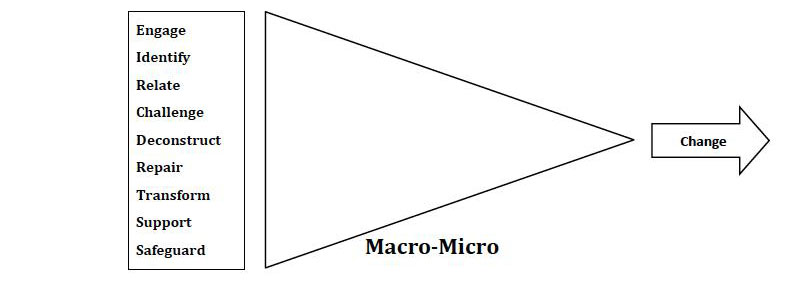
Common stages of recruitment include:
- Engagement & Profiling
Recruiters build rapport while assessing a target’s intellect, emotions, cultural background, values, beliefs, vulnerabilities, and skills. This phase is used to identify personal insecurities, grievances, or unmet needs. - Building Common Ground Through ongoing conversation, shared ideas, and selective agreement, recruiters establish trust, credibility, and emotional connection, creating a sense of belonging and validation.
- Challenging Existing Beliefs Once trust is secured, recruiters begin questioning and undermining the individual’s worldview, often using emotionally charged narratives
Recruitment targeted messages are designed to provoke guilt, anger, or moral urgency.
- Deconstruction of Identity & Values The recruiter gradually erodes existing beliefs, reframing personal, cultural, or religious values to align with extremist narratives.
- Reconstruction & Indoctrination New belief systems, loyalties, and identities are introduced and reinforced until the individual becomes fully psychologically committed to the ideology.
- Transformation The individual begins to reinterpret their life, relationships, and purpose through the extremist framework, often abandoning prior norms, goals, and moral reference points.
- Isolation from Family & Community Recruiters frequently pressure individuals to disengage from friends, family, and mainstream society, promoting the idea that separation is necessary to remain “pure” or “faithful.”
- Network Dependence & Control To prevent disengagement, recruiters may arrange relationships or marriages within their network and provide employment, housing, or financial support, increasing dependence and reducing the likelihood of exit.
The Fahmy Foundation works to redirect youth at risk by challenging how religious texts and concepts are distorted and weaponized by extremist networks, prioritizing prevention in hearts and minds rather than relying on surveillance alone.
Do you want to learn more about Prevention and Counter-Radicalization?
Redirecting Youth at Risk of Radicalization
Years of research, field observation, and collaboration with reformed Islamist extremists have shown that effective prevention requires patience, credibility, and deep ideological literacy. The Fahmy Foundation works to redirect young people at risk by addressing how religious texts and concepts are misinterpreted and weaponized by extremist networks, focusing on prevention in hearts and minds rather than surveillance alone.
- Lived experience shaping programme design and delivery
- Prevention and early intervention, not securitization
- Human-rights-centered and Charter-consistent practice
- Specialist expertise in Islamic extremist ideology and narratives
- Experiences of injustice, discrimination, or trauma
- Exposure to extremist or conspiratorial online content
- Ideological manipulation framed through religion or grievance
We deliver education programs and campaign to strengthen critical thinking, media literacy, and ideological awareness, with a particular focus on how Islamic extremist narratives distort theology, grievance, and identity.
Our approach draws on direct experience analyzing extremist messaging across borders and contexts, allowing participants to understand how and why these narratives resonate, and how they can be challenged safely and effectively.
Drawing on years of monitoring extremist digital ecosystems, our programs address how online platforms are used to amplify grievance, polarization, and religiously framed extremist narratives.
We support individuals and communities to critically engage with online content and resist manipulative messaging.
Practical outcomes include:
- Reduced engagement with harmful extremist content
- Improved digital literacy and critical information skills
Increased exposure to credible, alternative perspectives
The Fahmy Foundation prioritizes evidence-informed, outcome-focused delivery aligned with Canadian accountability standards.
Impact indicators include:
- Sustained disengagement from extremist narratives
- Improved wellbeing, resilience, and social connection
- Positive participation in education, employment, or civic life
- Reduced safeguarding and escalation concerns
Our work contributes directly to:
- Public Safety Canada’s prevention objectives
- Provincial and municipal community safety strategies
Social cohesion, inclusion, and resilience outcomes
For individuals already influenced by extremist ideology, the Fahmy Foundation offers voluntary disengagement and rehabilitation support, consistent with Canadian values of proportionality, rehabilitation, and reintegration.
Our lived experience enables engagement with individuals who may distrust institutional or authority-led interventions.
Key outcomes:
- Ideological and behavioral disengagement
- Improved emotional regulation and reflective thinking
- Reconnection with education, employment, or community life
- Safe and supported reintegration
Radicalization to violence in Canada is a serious but preventable challenge. While extremism takes many forms, the Fahmy Foundation’s current focus on Islamic extremist ideology reflects our distinct experience, credibility, and capacity to operate effectively in this space.
By combining lived experience, specialist expertise, and trusted community engagement, we deliver a human-rights-centered, approach to reduce harm and strengthen resilience.
Prevention works best when it is informed, inclusive, and rooted in trust.