

DEFENDING RIGHTS OF CANADIANS
ADVANCING JUSTICE ABROAD: LEGISLATIVE ACTION
After journalist Mohamed Fahmy endured 438 days of unjust detention in Egypt’s maximum-security prison system and was released following a presidential pardon, the Fahmy Foundation launched the Protection Charter in January 2016, in partnership with Amnesty International Canada.
The Charter is a 12-point legislative framework calling for a fundamental transformation in how Canada protects citizens detained abroad.
Publicly unveiled in Ottawa and formally submitted to the Government of Canada, the Protection Charter advocates for binding legal obligations that would require the government to provide meaningful assistance to Canadians imprisoned overseas. It seeks to replace the current discretionary approach — where consular support depends on political will — with a rights-based system grounded in accountability, due process, and the rule of law.
In January 2016, the Fahmy Foundation, in partnership with Amnesty International Canada, launched the Protection Charter—a 12-point legislative proposal calling for a fundamental reform of how Canada protects its citizens detained abroad.
The Charter was publicly presented in Ottawa and formally submitted to the Government of Canada. It calls for legislation that would mandate government assistance to Canadians imprisoned overseas, replacing the current discretionary system that leaves consular intervention to ministerial choice rather than legal obligation.
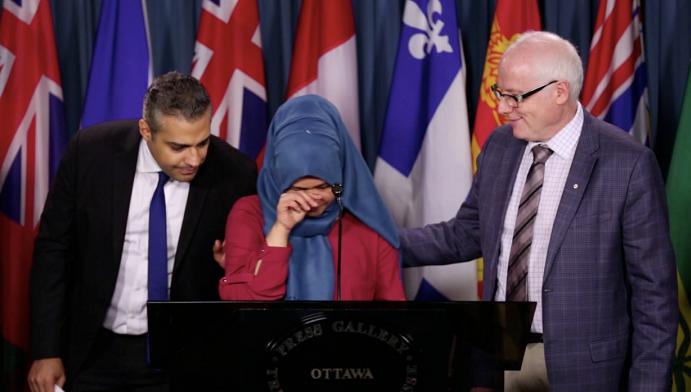
Kamila Telendibaeva speaks in support of her husband’s release with journalist Mohamed Fahmy and then Secretary General of Amnesty Canada Alex Neve during announcement of the Protection Charter in Ottawa on Jan. 26, 2016
At the Charter’s public launch, Fahmy stood at the podium with the wife of Huseyin Celil, a Canadian citizen and human rights advocate imprisoned in China since 2006 on politically motivated charges. His case remains a powerful reminder of the urgent need for stronger international protections and government accountability.
Mr. Celil remains imprisoned and facing grave human rights violations as of 2026.

Mr. Huseyin Celil is seen in this still photo captured from a family video during a citizen ceremony in November 16, 2005
Since its introduction, the Protection Charter has been endorsed by a broad coalition of human rights organizations, press freedom groups, former Canadian detainees, legal experts, diplomats, and civil society leaders. While not yet fully enacted into law, its proposals have reshaped national dialogue, strengthened policy frameworks, and advanced the fight for justice, consular accountability, and the protection of Canadians abroad.
WHY THE PROTECTION CHARTER IS NEEDED
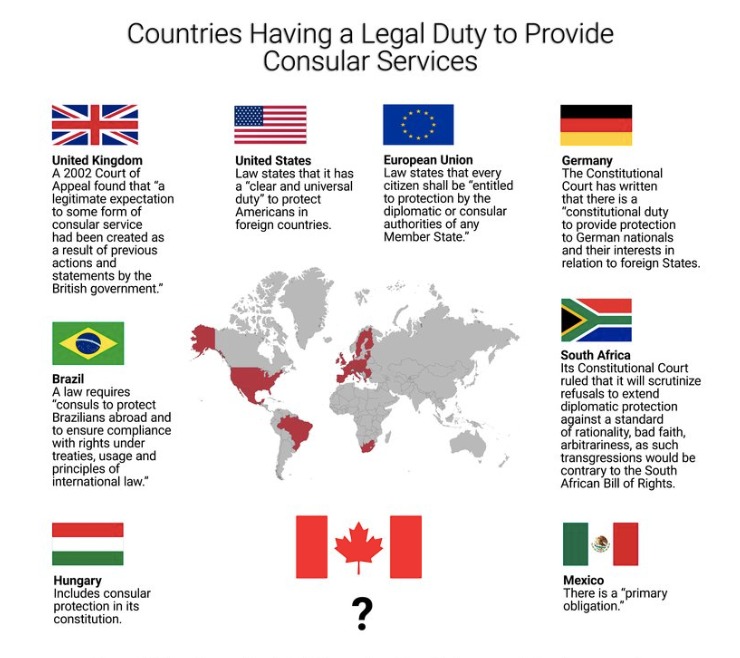
Many Canadians are surprised to learn that consular assistance is not guaranteed by law if they are detained abroad. Instead, intervention is left to the discretion of Global Affairs Canada. According to government estimates, approximately around 1,384 such cases recorded in the 2023-2024 fiscal year—many of them facing grave human rights violations.
While Canadian officials often do intervene, they are under no legal obligation to do so.
By contrast, countries including the United States, the United Kingdom, Germany, Brazil, South Africa, and at least 28 other nations have enshrined consular protection for detainees in federal law. Canada has not.
Discretion Is Not Protection
Under Canada’s current framework, the government “may take steps” to intervene when a Canadian’s human rights are violated abroad. This language—explicitly discretionary—means the government can theoretically choose to do nothing, or everything. The situation is even more precarious for dual citizens, where foreign governments may refuse to recognize Canadian citizenship, further limiting Ottawa’s willingness or ability to act.
Former Canadian ambassador and Director General of Consular Affairs Henry Garfield “Gar” Pardy has described this system as inequitable and inconsistent. In his 2016 report Canadians Abroad: A Policy and Legislative Agenda, released by the Rideau Institute and the Canadian Centre for Policy Alternatives, Pardy wrote:
“Hundreds languish in foreign prisons on specious charges.” He warned that Canada’s retreat from universal consular protection has resulted in unfairness, inconsistency, and legal uncertainty, forcing families to seek remedies through the courts rather than relying on their government."
The Protection Charter advances urgent reforms to strengthen how Canada protects citizens
detained abroad, including:
- Reviewing and strengthening intervention protocols to ensure more effective, timely,
and consistent government action in cases involving Canadians imprisoned overseas. - Updating consular protection policies, clarifying when ministerial involvement is required, improving responses to urgent medical cases, strengthening coordination with legal counsel, and ensuring families are kept fully informed throughout detention processes.
- Defending Canadian citizenship without exception, including in cases of dual nationality, and rejecting attempts by foreign governments to deny consular access or legal protections.
- Upholding international human rights standards, ensuring Canadian officials do not comply with unjust local laws that violate fundamental rights, due process, or international legal norms.
- Committing to seek clemency in all death penalty cases, affirming Canada’s obligation to protect the right to life and oppose capital punishment for Canadian citizens abroad.
As of 2026, the Canadian Consular Services Charter remains the primary document outlining government assistance for Canadian citizens abroad, though it maintains that such assistance is not a legally enforceable right.
The obligation to provide consular assistance — equally to all Canadians — must finally be enacted into law.
The Fahmy Foundation remains committed to advancing the Protection Charter until Canada meets its responsibility to its citizens abroad. Protection should not be optional. It should be the law.
Discretion Is Not Protection
Under Canada’s current framework, the government “may take steps” to intervene when a Canadian’s human rights are violated abroad. This language—explicitly discretionary—means the government can theoretically choose to do nothing, or everything. The situation is even more precarious for dual citizens, where foreign governments may refuse to recognize Canadian citizenship, further limiting Ottawa’s willingness or ability to act. Former Canadian ambassador and Director General of Consular Affairs Henry Garfield “Gar” Pardy has described this system as inequitable and inconsistent. In his 2016 report Canadians Abroad: A Policy and Legislative Agenda, released by the Rideau Institute and the Canadian Centre for Policy Alternatives, Pardy wrote that “hundreds languish in foreign prisons on specious charges.” He warned that Canada’s retreat from universal consular protection has resulted in unfairness, inconsistency, and legal uncertainty, forcing families to seek remedies through the courts rather than relying on their government."
Following his release in 2015, Fahmy partnered with Alex Neve, the Secretary General of Amnesty International Canada at the time to advocate for change. Together, they engaged senior government officials and parliamentary committees and testified before the House of Commons Standing Committee on Foreign Affairs and International Development (FAAE).
At the public announcement of the “Protection Charter” in Ottawa he was joined at the podium with the wife and children of Canadian citizen Huseyin Celil, a human rights activist jailed in China since March 2006 on trumped up charges related to terrorism. He remains imprisoned and facing grave human rights violations as of 2026.
The Protection Charter has since been endorsed by a broad coalition of human rights organizations, press freedom groups, former detainees, diplomats, lawyers, and civil society leaders. While its proposals have not yet been fully enacted into law, they have significantly advanced the national conversation around consular protection.
The Protection Charter calls for a new legal framework that would require the Canadian government to act when citizens are unjustly detained abroad.
While important details remain to be defined—such as the scope, timing, and nature of intervention—the principle is clear: citizens of a democratic country should not be abandoned to arbitrary detention, torture, or political imprisonment.
The next milestone in this effort is the introduction of a proposed law “bill” in Parliament, aimed at enshrining consular protection into Canadian law and ensuring that all Canadians receive equal protection, regardless of politics, profession, or place of detention.
As of 2026, the Canadian Consular Services Charter remains the primary document outlining government assistance for Canadian citizens abroad, though it maintains that such assistance is not a legally enforceable right.
The Fahmy Foundation remains committed to advancing the Protection Charter until Canada meets its responsibility to its citizens abroad. Protection should not be optional. It should be the law.